
What are vertically opposite angles?
Fact-checked:
Definition
Opposite angles that share a common vertex are called vertically opposite angles.
When one straight line intersects another straight line at a point, four angles are formed at the point of intersection. Each angle has another angle directly opposite to it, and these opposite angles are equal in measure. Such equal angles formed by the intersection of two straight lines are called vertically opposite angles.

In this geometric situation, two pairs of vertically opposite angles are formed, and the angles in each pair always have the same measure.
Example
$\overleftrightarrow{AB}$ and $\overleftrightarrow{CD}$ are two straight lines, which are intersected at point $O$ and four angles are formed geometrically by their intersection.
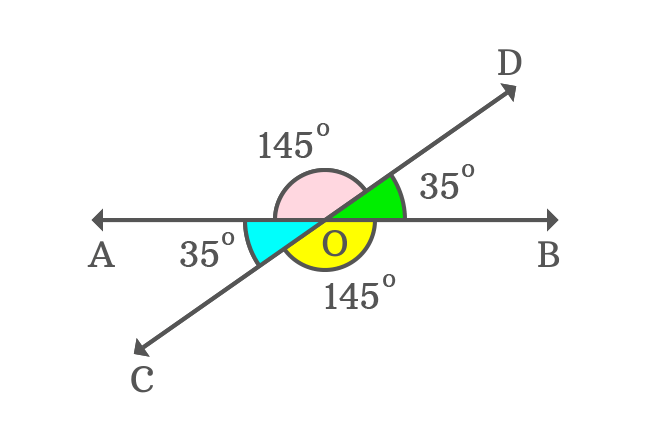
The point of intersection of them is called a vertical in this case and the four angles are measured as.
$(1). \,\,\,$ $\angle BOD$ $\,=\,$ $35^°$
$(2). \,\,\,$ $\angle DOA$ $\,=\,$ $145^°$
$(3). \,\,\,$ $\angle AOC$ $\,=\,$ $35^°$
$(4). \,\,\,$ $\angle COB$ $\,=\,$ $145^°$
In the point of view of vertical ($O$), the angles $\angle BOD$ and $\angle AOC$ are opposite to each other. So, they’re called as vertically opposite angles.
Similarly, the angles $\angle DOA$ and $\angle COB$ are also called as vertically opposite angles. Thus, the vertically opposite angles are formed geometrically.
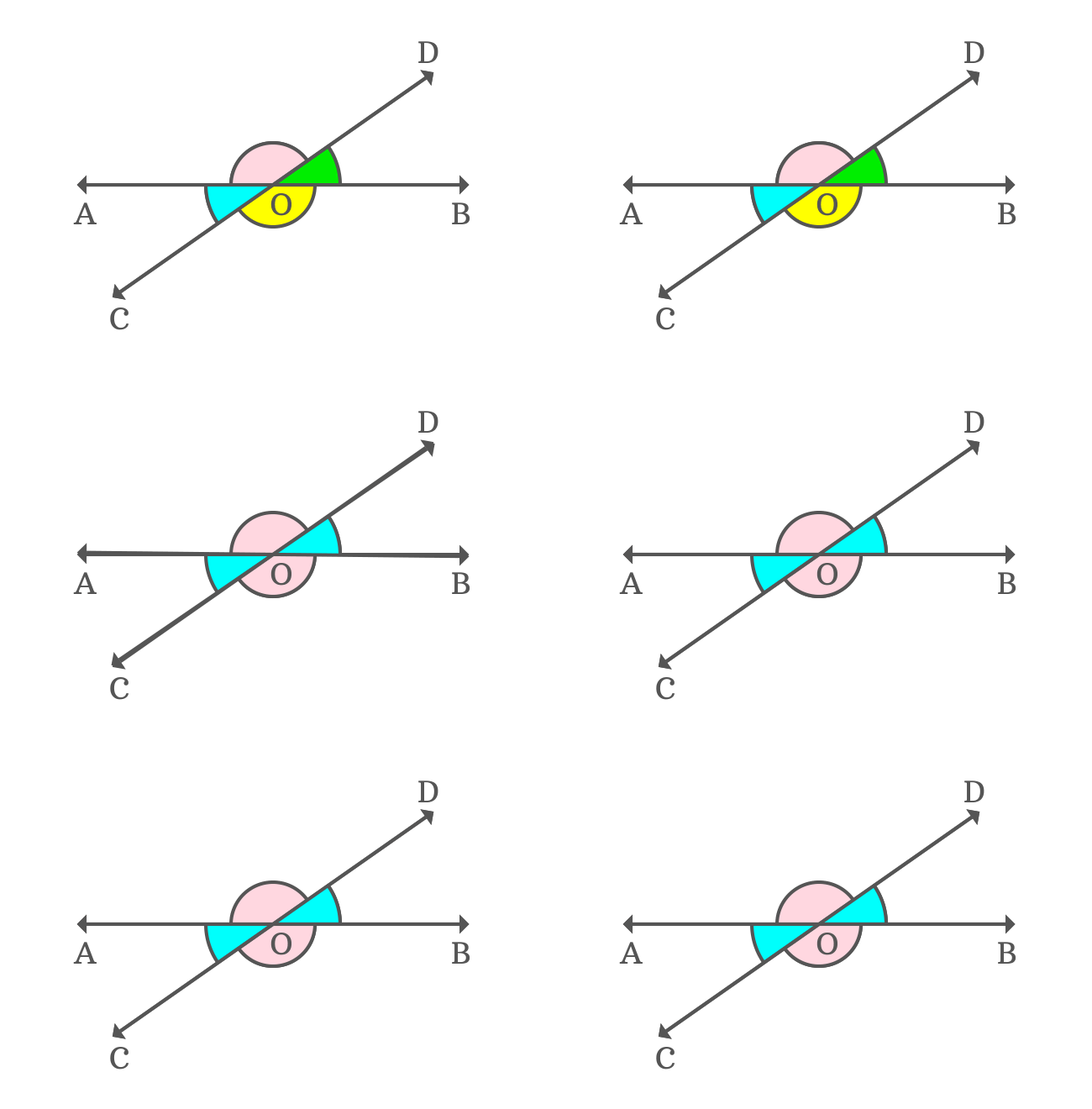
The vertically opposite angles $\angle BOD$ and $\angle AOC$ are equal and each angle is $35^°$. Similarly, the vertically opposite angles $\angle DOA$ and $\angle COB$ are also equal and each angle is $145^°$.
The $\angle DOA$ and $\angle AOC$ are adjacent angles and the sum of them forms a straight angle. Similarly, the $\angle BOD$ and $\angle COB$ are also adjacent angles and the sum of them is also equal to $180^°$.
If one pair of adjacent angles are rotated by $180^°$, they are exactly same as the other pair of adjacent angles.
It makes one pair of vertically opposite angles becomes other pair of vertically opposite angles geometrically. Therefore, the vertically opposite angles are always equal geometrically.