
Cot of angle sum identity
Fact-checked:
Formula
$(1).\,\,$ $\cot{(a+b)}$ $\,=\,$ $\dfrac{\cot{b}\cot{a}-1}{\cot{b}+\cot{a}}$
$(2).\,\,$ $\cot{(x+y)}$ $\,=\,$ $\dfrac{\cot{y}\cot{x}-1}{\cot{y}+\cot{x}}$
Introduction
Let’s assume that $a$ and $b$ are two variables, which are used to represent two angles. In mathematics, the sum of two angles is written as $a+b$, which is actually a compound angle. The cotangent of a compound angle $a$ plus $b$ is written as $\cot{(a+b)}$ in trigonometric mathematics.
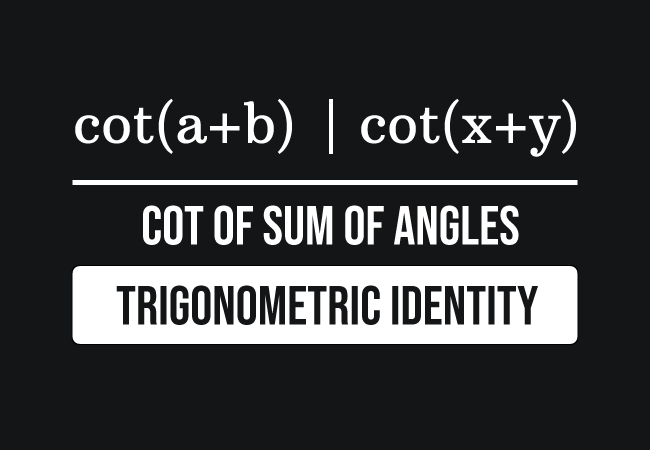
The cotangent of the sum of angles $a$ and $b$ is equal to the quotient of the subtraction of one from the product of cotangents of angles $a$ and $b$ by the sum of the cotangents of angles $a$ and $b$.
$\cot{(a+b)}$ $\,=\,$ $\dfrac{\cot{b} \times \cot{a}-1}{\cot{b}+\cot{a}}$
This mathematical equation is called the cotangent of angle sum trigonometric identity in mathematics.
Usage
The cot angle sum identity is possibly used in two cases in trigonometric mathematics.
Expansion
The cot of the sum of two angles is expanded as the quotient of the subtraction of one from the product of cotangents of angles by the sum of the cotangents of angles.
$\implies$ $\cot{(a+b)}$ $\,=\,$ $\dfrac{\cot{(b)}\cot{(a)}-1}{\cot{(b)}+\cot{(a)}}$
Simplification
The quotient of the subtraction of one from the product of cotangents of angles by the sum of the cotangents of angles is simplified as the cot of the sum of two angles.
$\implies$ $\dfrac{\cot{(b)}\cot{(a)}-1}{\cot{(b)}+\cot{(a)}}$ $\,=\,$ $\cot{(a+b)}$
Forms
The angle sum trigonometric formula in cotangent function is written in several forms but it is popularly expressed in the following three forms.
$(1).\,\,$ $\cot{(A+B)}$ $\,=\,$ $\dfrac{\cot{B}\cot{A}-1}{\cot{B}+\cot{A}}$
$(2).\,\,$ $\cot{(x+y)}$ $\,=\,$ $\dfrac{\cot{y}\cot{x}-1}{\cot{y}+\cot{x}}$
$(3).\,\,$ $\cot{(\alpha+\beta)}$ $\,=\,$ $\dfrac{\cot{\beta}\cot{\alpha}-1}{\cot{\beta}+\cot{\alpha}}$
Proof
Learn how to derive the cot of angle sum trigonometric identity by a geometric method in trigonometry.