
Pythagorean identity of Secant and Tangent functions
Fact-checked:
Formula
$\sec^2{\theta}-\tan^2{\theta} \,=\, 1$
The subtraction of square of tan function from square of secant function equals to one is called the Pythagorean identity of secant and tangent functions.
Introduction
In trigonometry, the secant and tangent are two functions, and they have a direct relation between them in square form but their relationship is derived from Pythagorean theorem. Therefore, the relation between secant and tangent functions in square form is called the Pythagorean identity of secant and tangent functions.
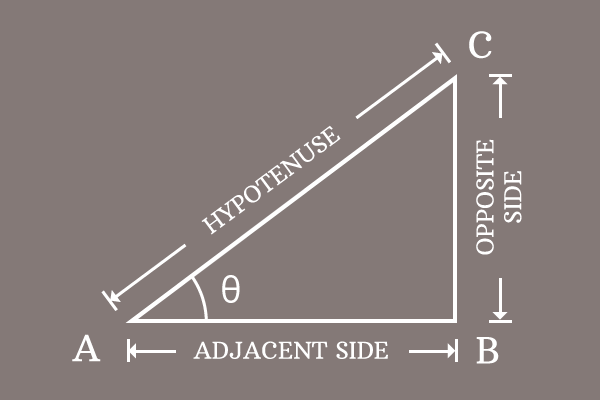
- $\Delta CAB$ is a right triangle and its angle is denoted by the symbol theta.
- The secant and tangent functions are written as $\sec{\theta}$ and $\tan{\theta}$ respectively.
- Similarly, their squares are written as $\sec^2{\theta}$ and $\tan^2{\theta}$ respectively in mathematical form.
The subtraction of the tan squared of angle from secant squared of angle is equal to one and it is called as the Pythagorean identity of secant and tangent functions.
$\sec^2{\theta}-\tan^2{\theta} \,=\, 1$
Popular forms
The Pythagorean identity of secant and tan functions can also be written popularly in two other forms.
- $\sec^2{x}-\tan^2{x} \,=\, 1$
- $\sec^2{A}-\tan^2{A} \,=\, 1$
Remember, the angle of a right triangle can be represented by any symbol but the relationship between secant and tan functions must be written in that symbol.
Proof
Learn how to prove the Pythagorean identity of secant and tan functions in mathematical form by geometrical method.