
Prove $\log{(1+2+3)}$ $\,=\,$ $\log{(1)}$ $+$ $\log{(2)}$ $+$ $\log{(3)}$
The given logarithmic equation asks us to prove that the logarithm of the sum of three numbers equals the sum of their logarithms. In general, this statement is not valid because logarithms convert multiplication into addition, not sums into sums.
$\,\,\,\,\therefore\,\,\,\,\,$ $\log{(a+b+c)}$ $\,\ne\,$ $\log{(a)}$ $+$ $\log{(b)}$ $+$ $\log{(c)}$
In this specific numerical case, we show that $\log{(1+2+3)}$ equals $\log{(1)}$ $+$ $\log{(2)}$ $+$ $\log{(3)}$. This equality does not hold in general for arbitrary numbers.
Now, let’s apply the laws of logarithms and examine why, for the numbers $1$, $2$, and $3$, the logarithm of their sum equals the sum of their logarithms in this special case.
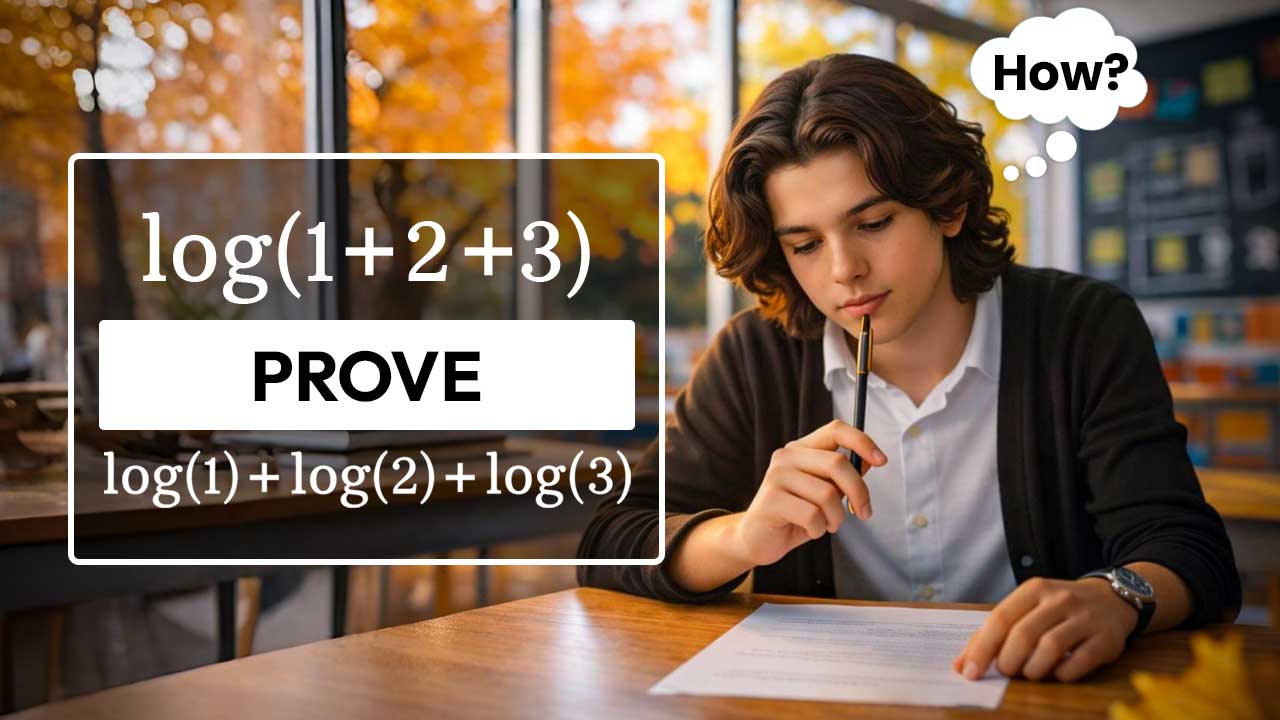
This is one of the most important difficult logarithm problems in arithmetic form and is well-suited for beginners to learn logarithmic properties.
Find the Sum Inside the Logarithm
Look at the argument of the logarithmic expression on the left-hand side of the equation. It contains an arithmetic expression in addition form. Therefore, let us find its value by adding the three numbers $1$, $2$, and $3$.
$\implies$ $\log{(1+2+3)}$ $\,=\,$ $\log{(6)}$
Thus, the logarithm of the sum of the numbers $1$, $2$, and $3$ is equal to the logarithm of $6$.
Express the Sum in Product Form
The unique factor pairs of six, without repetition, are $(1, 6)$ and $(2, 3)$. Now, let us express the number $6$ as a product of its factors.
$\implies$ $\log{(6)}$ $\,=\,$ $\log{(1 \times 6)}$
$\,\,\,\,\therefore\,\,\,\,\,$ $\log{(1+2+3)}$ $\,=\,$ $\log{(1 \times 2 \times 3)}$
Thus, the logarithm of the sum of $1$, $2$, and $3$ can be expressed as the logarithm of the product of the numbers $1$, $2$, and $3$. This equality holds only as a special numerical case, because the sum $(1+2+3 = 6)$ and the product of the numbers $(1\times 2\times 3 = 6)$ are equal, and it is not a general property of logarithms.
Apply the Product Rule of Logarithms
According to the product rule of logarithms, the logarithm of a product of three numbers $1$, $2$, and $3$ can be expressed as the sum of their individual logarithms.
$\implies$ $\log{(1+2+3)}$ $\,=\,$ $\log{(1 \times 2 \times 3)}$ $\,=\,$ $\log{(1)}$ $+$ $\log{(2)}$ $+$ $\log{(3)}$
For the specific numbers $1$, $2$, and $3$, the equality holds because their sum and their product are both equal to $6$.
$\,\,\,\,\therefore\,\,\,\,\,$ $\log{(1+2+3)}$ $\,=\,$ $\log{(1)}$ $+$ $\log{(2)}$ $+$ $\log{(3)}$
Therefore, it is proved that the log of sum of numbers $1$, $2$ and $3$ is equal to the sum of the logs of $1$, $2$ and $3$.
Not a General Logarithmic Identity
Remember, this equality cannot be considered a logarithmic identity, because, in general, the logarithm of a sum is not equal to the sum of the logarithms. This fact can be observed from the following example.
$\implies$ $\log{(1+2+4)}$ $\,=\,$ $\log{(7)}$ but $\log{(1)}$ $+$ $\log{(2)}$ $+$ $\log{(4)}$ $\,=\,$ $\log{(8)}$
$\,\,\,\,\therefore\,\,\,\,\,$ $\log{(1+2+4)}$ $\,\ne\,$ $\log{(1)}$ $+$ $\log{(2)}$ $+$ $\log{(4)}$