
Cofactors of a 2×2 Matrix
Fact-checked:
Each minor of a two by two matrix with a sign is called the cofactor of an entry in a square matrix of the order two.
Introduction
In a two by two matrix, the cofactor of an entry is calculated by multiplying the following two factors.
- The negative one raised to the power of sum of the number of the row and the number of the column of the corresponding element.
- The minor of the respective entry.
Let us learn how to find the cofactor of every entry for the following example matrix.
$B$ $\,=\,$ $\begin{bmatrix} b_{11} & b_{12} \\ b_{21} & b_{22} \\ \end{bmatrix}$
It is essential to learn how to find the minors of entries in a square matrix of the order two.
Cofactor of an entry in the first row and the first column
$b_{11}$ is the entry in the first row and the first column. Now, find the minor of this element.
$M_{11} \,=\, \begin{vmatrix} b_{22} \\ \end{vmatrix}$
$\therefore \,\,\,$ $M_{11} \,=\, b_{22}$
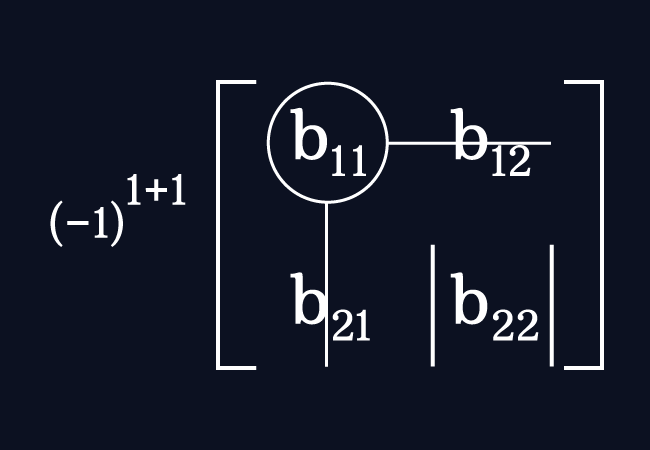
The cofactor of the element $b_{11}$ is denoted by $C_{11}$. For the element $b_{11}$, the number of the row is $1$ and the number of the column is $1$.
The cofactor of the entry $b_{11}$ is calculated by multiplying the minor of this entry with the negative one raised to the power of the sum of $1$ and $1$.
$C_{11} \,=\, (-1)^{1+1} \times M_{11}$
$\implies$ $C_{11} \,=\, (-1)^{1+1} \times b_{22}$
$\implies$ $C_{11} \,=\, (-1)^{2} \times b_{22}$
$\implies$ $C_{11} \,=\, 1 \times b_{22}$
$\,\,\,\therefore\,\,\,\,\,\,$ $C_{11} \,=\, b_{22}$
Therefore, the cofactor of the element $b_{11}$ in the matrix $B$ is positive $b_{22}$.
Cofactor of an entry in the first row and the second column
$b_{12}$ is the entry at the first row and the second column. Now, let’s find the minor of this element.
$M_{12} \,=\, \begin{vmatrix} b_{21} \\ \end{vmatrix}$
$\therefore \,\,\,$ $M_{12} \,=\, b_{21}$
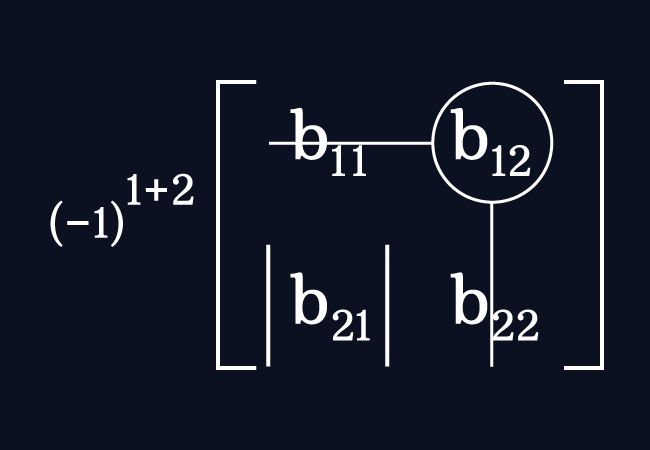
The cofactor of the element $b_{12}$ is denoted by $C_{12}$. For the element $b_{12}$, the number of the row is $1$ and the number of the column is $2$.
The cofactor of the entry $b_{12}$ is evaluated by multiplying the minor of this element with the negative one raised to the power of the sum of $1$ and $2$.
$C_{12} \,=\, (-1)^{1+2} \times M_{12}$
$\implies$ $C_{12} \,=\, (-1)^{1+2} \times b_{21}$
$\implies$ $C_{12} \,=\, (-1)^{3} \times b_{21}$
$\implies$ $C_{12} \,=\, (-1) \times b_{21}$
$\,\,\,\therefore\,\,\,\,\,\,$ $C_{12} \,=\, -b_{21}$
Therefore, the cofactor of the element $b_{12}$ in the matrix $B$ is negative $b_{21}$.
Cofactor of an entry in the second row and the first column
$b_{21}$ is the entry at the second row and the first column. Now, let us evaluate the minor of this entry.
$M_{21} \,=\, \begin{vmatrix} b_{12} \\ \end{vmatrix}$
$\therefore \,\,\,$ $M_{21} \,=\, b_{12}$
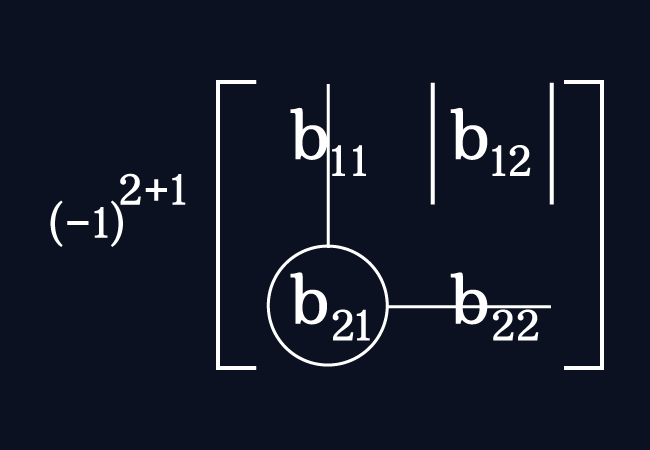
The cofactor of the element $b_{21}$ is denoted by $C_{21}$. For the entry $b_{21}$, the number of the row is $2$ and the number of the column is $1$.
The cofactor of the entry $b_{21}$ is evaluated by multiplying the minor of this element with the negative one raised to the power of the sum of $2$ and $1$.
$C_{21} \,=\, (-1)^{2+1} \times M_{21}$
$\implies$ $C_{21} \,=\, (-1)^{2+1} \times b_{12}$
$\implies$ $C_{21} \,=\, (-1)^{3} \times b_{12}$
$\implies$ $C_{21} \,=\, (-1) \times b_{12}$
$\,\,\,\therefore\,\,\,\,\,\,$ $C_{21} \,=\, -b_{12}$
Therefore, the cofactor of the entry $b_{21}$ in the matrix $B$ is negative $b_{12}$.
Cofactor of an entry in the second row and the second column
$b_{22}$ is the entry in the second row and the second column. Now, let us evaluate the minor of this entry.
$M_{22} \,=\, \begin{vmatrix} b_{11} \\ \end{vmatrix}$
$\therefore \,\,\,$ $M_{22} \,=\, b_{11}$
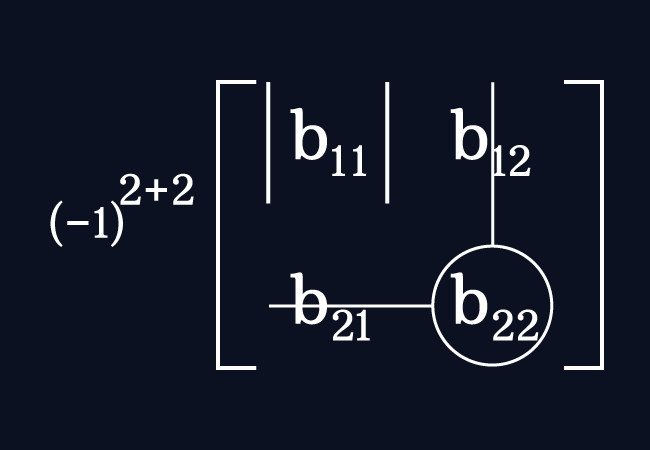
The cofactor of the element $b_{22}$ is represented by $C_{22}$. For the entry $b_{22}$, the number of the row is $2$ and the number of the column is $2$.
The cofactor of the entry $b_{22}$ is calculated by multiplying the minor of this entry with the negative one raised to the power of the sum of $2$ and $2$.
$C_{22} \,=\, (-1)^{2+2} \times M_{22}$
$\implies$ $C_{22} \,=\, (-1)^{2+2} \times b_{11}$
$\implies$ $C_{22} \,=\, (-1)^{4} \times b_{11}$
$\implies$ $C_{22} \,=\, 1 \times b_{11}$
$\,\,\,\therefore\,\,\,\,\,\,$ $C_{22} \,=\, b_{11}$
Therefore, the cofactor of the element $b_{22}$ in the matrix $B$ is positive $b_{11}$.
Signs
A sign technique can be used as a shortcut method while finding the cofactors of entries in a $2 \times 2$ matrix.
$B$ $\,=\,$ $\begin{bmatrix} + & – \\ b_{11} & b_{12} \\ – & + \\ b_{21} & b_{22} \\ \end{bmatrix}$
- In the first row, write a plus sign above the first element and a negative sign over the second element.
- In the second row, write a minus sign above the first element and a positive sign over the second element.
Now, let’s find the cofactors of the elements for the above matrix.
- $C_{11} \,=\, +M_{11} \,=\, +\begin{vmatrix} b_{22} \\ \end{vmatrix} \,=\, b_{22}$
- $C_{12} \,=\, -M_{12} \,=\, -\begin{vmatrix} b_{21} \\ \end{vmatrix} \,=\, -b_{21}$
- $C_{21} \,=\, -M_{21} \,=\, -\begin{vmatrix} b_{12} \\ \end{vmatrix} \,=\, -b_{12}$
- $C_{22} \,=\, +M_{22} \,=\, +\begin{vmatrix} b_{11} \\ \end{vmatrix} \,=\, b_{11}$
Remember that this shortcut method is recommendable to use for verifying our fundamental process and also to get the result quickly.
Example
$A$ $\,=\,$ $\begin{bmatrix} 5 & 3 \\ -2 & 6 \\ \end{bmatrix}$
Let’s find the cofactors of the entries in the the matrix $A$ of the order $2$.
$(1).\,\,\,$ $C_{11} \,=\, (-1)^{1+1}\begin{vmatrix} 6 \\ \end{vmatrix} \,=\, +\begin{vmatrix} 6 \\ \end{vmatrix} \,=\, 6$
The cofactor of the entry five is positive six.
$(2).\,\,\,$ $C_{12} \,=\, (-1)^{1+2}\begin{vmatrix} -2 \\ \end{vmatrix} \,=\, -\begin{vmatrix} -2 \\ \end{vmatrix} \,=\, -(-2)$ $\,=\,$ $2$
The cofactor of the entry three is positive two.
$(3).\,\,\,$ $C_{21} \,=\, (-1)^{2+1}\begin{vmatrix} 3 \\ \end{vmatrix} \,=\, -\begin{vmatrix} 3 \\ \end{vmatrix} \,=\, -3$
The cofactor of the entry negative two is negative three.
$(4).\,\,\,$ $C_{22} \,=\, (-1)^{2+2}\begin{vmatrix} 6 \\ \end{vmatrix} \,=\, +\begin{vmatrix} 5 \\ \end{vmatrix} \,=\, 5$
The cofactor of the entry six is positive five.
In this way, the cofactor of every element can be calculated in a square matrix of the order two.