
Equation of a circle when the circle touches the both axes
Fact-checked:
Equation
$(1).\,\,$ $(x-a)^2+(y-a)^2$ $\,=\,$ $a^2$
$(2).\,\,$ $(x-b)^2+(y-b)^2$ $\,=\,$ $b^2$
$(3).\,\,$ $(x-r)^2+(y-r)^2$ $\,=\,$ $r^2$
Introduction
A circle that touches both horizontal and vertical axes of two dimensional Cartesian coordinate system can be expressed in mathematical form by an equation and it is called the equation of a circle when the circle is touching the both axes.

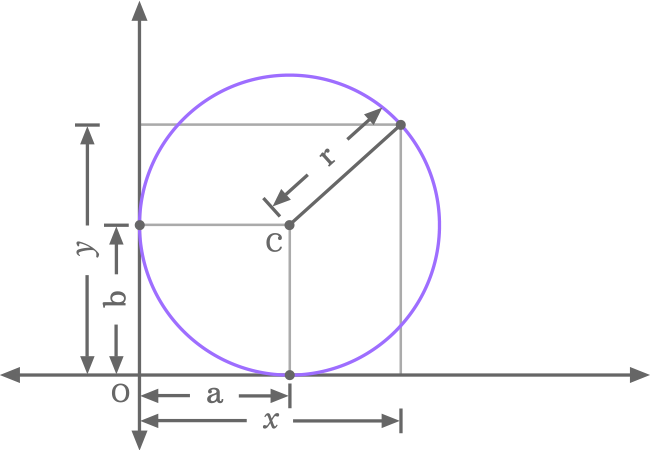
Let the coordinates of center (or centre) of a circle are denoted by $a$ and $b$, and the geometric coordinates of a point on the circumference of a circle are denoted by $x$ and $y$, and the radius of circle is denoted by $r$. Then, the equation of a circle, which touches the both horizontal $x$ axis and vertical $y$ axis of a two dimensional space is written as follows.
Simple form
$(1).\,\,$ $(x-a)^2+(y-a)^2$ $\,=\,$ $a^2$
$(2).\,\,$ $(x-b)^2+(y-b)^2$ $\,=\,$ $b^2$
$(3).\,\,$ $(x-r)^2+(y-r)^2$ $\,=\,$ $r^2$
Expansion
$(1).\,\,$ $x^2$ $+$ $y^2$ $-$ $2a(x+y)$ $+$ $a^2$ $\,=\,$ $0$
$(2).\,\,$ $x^2$ $+$ $y^2$ $-$ $2b(x+y)$ $+$ $b^2$ $\,=\,$ $0$
$(3).\,\,$ $x^2$ $+$ $y^2$ $-$ $2r(x+y)$ $+$ $r^2$ $\,=\,$ $0$
Other form
The equation of a circle, which touches the both horizontal axis and vertical axis is also written in the following form by taking $C(h, k)$ as the center or centre of a circle in coordinate form.
Simple form
$(1).\,\,$ $(x-h)^2+(y-h)^2$ $\,=\,$ $h^2$
$(2).\,\,$ $(x-k)^2+(y-k)^2$ $\,=\,$ $k^2$
$(3).\,\,$ $(x-r)^2+(y-r)^2$ $\,=\,$ $r^2$
Expansion
$(1).\,\,$ $x^2$ $+$ $y^2$ $-$ $2h(x+y)$ $+$ $h^2$ $\,=\,$ $0$
$(2).\,\,$ $x^2$ $+$ $y^2$ $-$ $2k(x+y)$ $+$ $k^2$ $\,=\,$ $0$
$(3).\,\,$ $x^2$ $+$ $y^2$ $-$ $2r(x+y)$ $+$ $r^2$ $\,=\,$ $0$
Proof
Learn how to derive the equation of a circle that touches the both horizontal and vertical axes.