
Zero Product property
Fact-checked:
Property
If $a \times b \,=\, 0$ then $a \,=\, 0$ or $b \,=\, 0$
A product rule of two or more quantities when their product equals to zero, is called the zero product property.
Introduction
Two or more quantities are involved in multiplication for expressing their product in mathematical form. The product of the quantities can be zero in a special case and it is possible only if one of the quantities is zero. Hence, the property is called the zero product property.
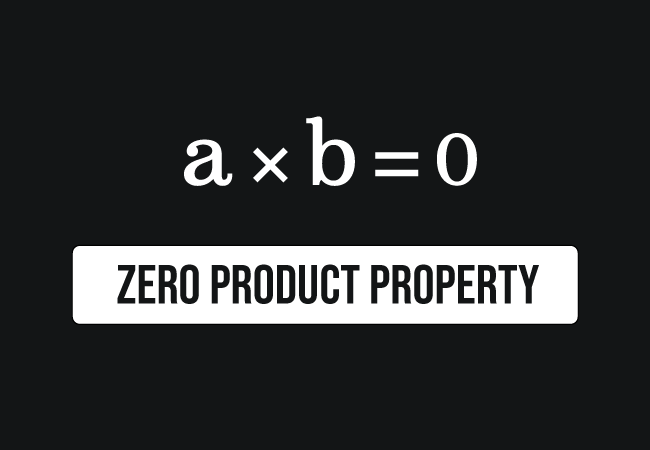
Let $a$ and $b$ be two quantities in algebraic form. The multiplication of them is written mathematically as follows.
$a \times b$
Let’s assume that the product of the quantities $a$ and $b$ is zero.
$\implies$ $a \times b = 0$
In this case, there are two possibilities for their product to become zero.
$(1).\,\,\,$ If $a \,=\, 0$ then $0 \times b \,=\, 0$.
$(2).\,\,\,$ If $b \,=\, 0$ then $a \times 0 \,=\, 0$.
Therefore, the product of the quantities $a$ and $b$ is equal to zero when $a$ is equal to zero or $b$ is equal to zero. This rule is called the zero product property.
The zero product rule can also be applicable to more than two quantities.
$a \times b \times c \times \cdots$ $\,=\,$ $0$ where $a \,=\, 0$ or $b \,=\, 0$ or $c \,=\, 0$ and so on.
Examples
The zero product property can be understood from the following numerical examples.
$(1).\,\,\,$ $0 \times 2 \,=\, 0$
$(2).\,\,\,$ $7 \times 0 \,=\, 7$
$(3).\,\,\,$ $5 \times 0 \times 6\,=\, 0$