
Approach
Fact-checked:
The word “Approach” is used frequently in limits. If you are a beginner, you must first have to know what really it is. According to English language, the meaning of approach is come near. Similarly, another word “Tend” is also used instead of approach and its meaning is approach a quantity. So, both of them can be used in calculus.
What is Approach or Tend?
A location on the plane is usually denoted by a point in geometry. Now, look at the below visual example, in which you see three points on the plane.

The middle point is not moving in any direction but both left-side and right-side points move towards the middle point. Finally, they come near to the middle point on the plane. So, the words “Approach” or “Tend” are used to express it verbally in calculus as follows.
- The left hand side point approaches to the middle point, which means the left hand side point comes near to the middle point.
- The right hand side point tends to the middle point, which means the right hand side point comes near to the middle point.
The above simple explanation with visual example helps you to understand the purpose of using the words “Approach” or “Tend” generally in mathematics.
Notation
The words “Approach” or “Tend” both are represented by the right arrow symbol ($\rightarrow$) in mathematics.
How to use it in Calculus?
Let’s identity a point on the plane and its value is denoted by a constant $a$. Similarity, let’s identity another point on the plane and its value is denoted by a variable $x$.

The left-hand side point comes near to the fixed point on the plane, which means the value of $x$ is closer to the value of $a$ and it is mathematically written as $x \, \rightarrow \, a$ in calculus. It is expressed orally as follows.
- $x$ approaches $a$
- $x$ tends to $a$
Example
Let’s understand the concept of Approach practically from an arithmetic example $x \, \rightarrow \, 6$.
Let’s consider a line on the plane and divide it into six equal parts. Each division is denoted by a number. Now, imagine a point at origin. It moves from origin to right hand side, which means its location is changed every time. So, its location is denoted by a variable $x$.
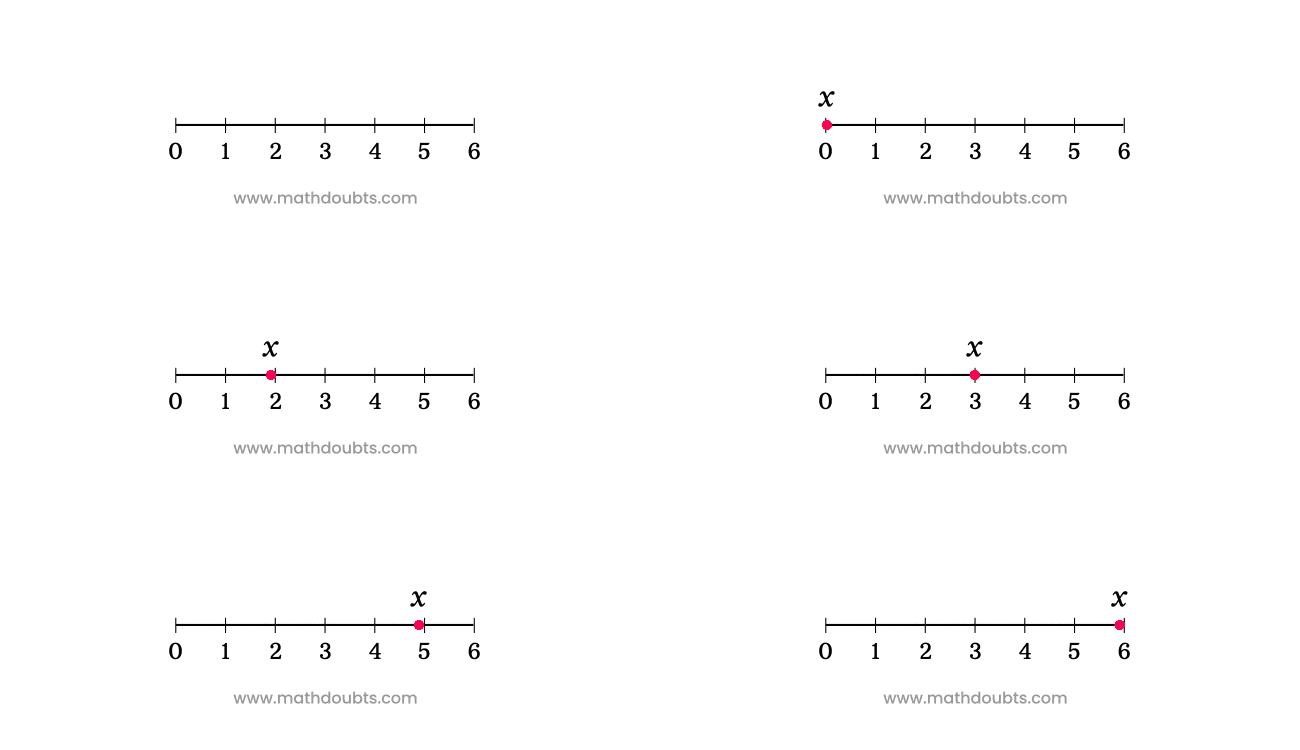
The point moves from $0$ to $1$, from $1$ to $2$, from $2$ to $3$, from $3$ to $4$ and from $4$ to $5$. So, the location of point is $x = 0$, $x = 1$, $x = 2$, $x = 3$, $x = 4$ and $x = 5$ at that time.
- The point started from $x = 5$, it comes near to $6$ but it is not coinciding with the divisional line of $6$, which means the value of $x$ is not equal to $6$ ($x \ne 6$). It is obvious that the value of $x$ is slightly less than $6$ ($x < 6$). It is expressed as $x$ approaches to $6$ and it is written as $x \, \rightarrow \, 6$ in calculus.
- The meaning $x \, \rightarrow \, 6$ is the value of $x$ is closer to $6$, which means the value of $x$ can be $5.9$, $5.99$, $5.999$, $5.9999$ and so on, which means $x \approx 6$.
The above example explained you the purpose of approach or tend in limits from the above simple examples. Now, you are ready to start learning the limits in calculus.