
Surds
Fact-checked:
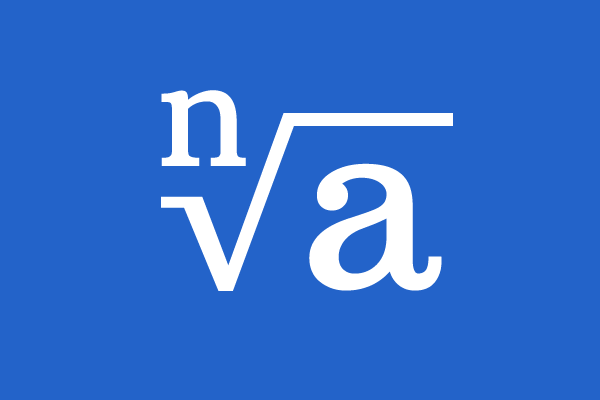
Definition
A positive integer root of a rational number is called a surd or a radical.
The irrational numbers are very special real numbers and no finite number of digits can represent them. However, some types of irrational numbers can be expressed in various roots of rational numbers and this type of representing an irrational number as a root of a rational number is called a surd.
Example
$(1) \,\,\,\,\,$ $1.41421356237309504 \cdots$
$1.41421356237309504 \cdots$ is an irrational number. It is not possible to write it as a rational number and the value of this number cannot be written in number system completely. However, it can be written as a square root of the number $2$.
$\sqrt{2} = 1.41421356237309504 \cdots$
Observe the following few more examples for your better understanding.
$(2) \,\,\,\,\,$ $\sqrt[\displaystyle 3]{5} = 1.70997594667669 \cdots$
$(3) \,\,\,\,\,$ $\sqrt[\displaystyle 4]{2} = 1.18920711500272 \cdots$
$(4) \,\,\,\,\,$ $\sqrt[\displaystyle 5]{121} = 2.60949863527887 \cdots$
$(5) \,\,\,\,\,$ $\sqrt[\displaystyle 6]{7} = 1.38308755426848 \cdots$
In this way, some irrational numbers are written in simple form.
Algebraic form
If $n$ is a positive integer and $a$ is a rational number then a surd is written in algebraic form.
$\sqrt[\displaystyle n]{\displaystyle a}$
The value of $n$ is a positive integer and the value of $a$ is a position rational number. Therefore, the value of the surd is always positive.