
Multiplicative inverse
When the product of two quantities equals to one, one quantity is called a multiplicative inverse (or reciprocal) of another quantity.
Introduction
The quantities are often involved in multiplication in mathematics. In a special case, the product of two quantities is equal to one. It is possible when a quantity is in opposite form in another quantity.
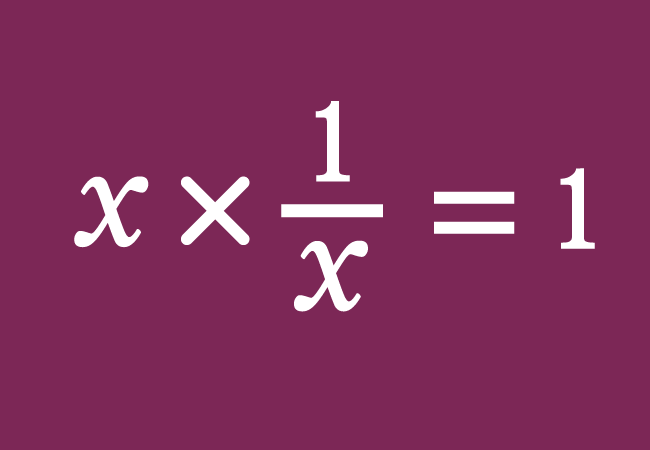
- In some cases, the meaning of opposite is expressed by a word “inverse” in mathematics.
- The product of two quantities equals to one is actually calculated by the multiplication.
According to these two considerable factors, one quantity is called a multiplicative inverse of the remaining quantity.
For example, $6$ and $\dfrac{1}{6}$ are two quantities and multiply them to get their product.
$6 \times \dfrac{1}{6}$
$=\,\,\,$ $\dfrac{6}{1} \times \dfrac{1}{6}$
$=\,\,\,$ $\dfrac{6 \times 1}{1 \times 6}$
$=\,\,\,$ $\dfrac{6}{6}$
$=\,\,\,$ $\dfrac{\cancel{6}}{\cancel{6}}$
$=\,\,\,$ $1$
Therefore, it is cleared that the product of a quantity and quotient of one by the same quantity is equal to one.
$\therefore\,\,\,$ $6 \times \dfrac{1}{6}$ $\,=\,$ $1$
Therefore, the number $\dfrac{1}{6}$ is called the multiplicative inverse or reciprocal of the number $6$ and vice-versa.
Algebraic form
Let $x$ be a variable and it represents a quantity. The second quantity is unknown. So, it can be denoted by a variable $y$. Assume that the product of both variables is equal to one.
$x \times y \,=\, 1$
Now, we can evaluate the variable $y$ in terms of $x$.
$\implies$ $y \,=\, \dfrac{1}{x}$
Therefore, the variable $y$ is equal to the quotient of one by $x$.
$(1).\,\,\,$ $\dfrac{1}{x}$ is called the multiplicative inverse of $x$.
$(2).\,\,\,$ $x$ is called the reciprocal of the $\dfrac{1}{x}$
Remember that, $\dfrac{1}{x}$ is simply written as $x^{-1}$ in mathematics.